Keeping
the jukes jumping
They
are to the music industry what unicorns are to
reality:
magical, mythical beasts. But spinning those tunes
on vinyl,
they're the life of the party.
By Dean Kuipers, Special to The Times
August 10, 2006
 |
| At
your service |
 |
| Vinyl
fetish |
 |
| Petty
cache |
|
Don
MULLER stands in his living room, grinning like a
caffeinated teenager, clearly dazzled by the magic he
has wrought. The playroom in his Van Nuys ranch
home features four classic jukeboxes crowded around a
small dance floor, and lightbulbs are flashing like an
arcade around the room and across the ceiling.
"See
how this model has a speaker on top?" he shouts,
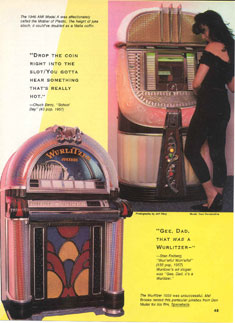
patting a 1946 AMI "mother-of-plastic" Model A
jukebox, as Eddie Cochran's "Summertime Blues"
comes blasting out at about ear-level. "That
was so it would play over the top of the tables.
See, this would be the music for a whole restaurant or
dance hall, and it only took one machine in the corner
to do it. It really kicks it out!"
Muller
is clearly enjoying himself, and his enthusiasm is
infectious. To thousands of Southern Californians
who own jukeboxes that play vinyl records, and the
smattering of restaurants and bars that still keep them
around, he is something of a guru, a figure familiar to
the rich and famous, to music junkies and nostalgia
freaks. Now in his 35th year as sole proprietor of
Jukeboxes Unlimited, Muller has seen the industry turn
toward CD jukes and, recently, to Internet-connected
players that download songs from massive
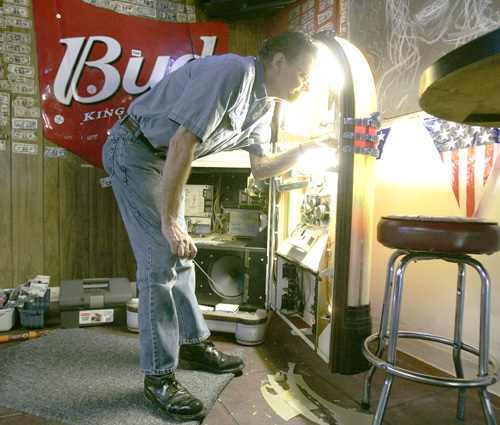
databases. He is one of only two guys in L.A. who
still make house calls to service record-playing
jukeboxes. He's a gadget freak and is the first
one to admit it.
But
it would be a mistake to think that the jukebox fetish
is all about these lights and bubbles and fake
mother-of-pearl.
"Oh,
no," he says, his face getting serious. He stops
what he's doing, which is punching up song after
song. "I need to show you something."
We
move swiftly through the back door. Behind his
house is another building, a garage the size of a small
barn. He swings the door open and says, "This
is a lifetime's worth of music."
It's
more than that. It's several dozen lifetimes' worth.
It's the most staggering collection of vinyl imaginable.
In that garage, loosely arranged on floor-to-ceiling
shelves, in banana boxes, in crates, in retail record
racks, are approximately 300,000 records.
Seventy-eight RPMs, 45s, LPs, picture discs. Most
of them are popular titles from every decade from the
1930s to the present, but there are also box sets, rare
pressings, promos, a thousand Frank Sinatra discs, and a
lot of Christmas music. That's what the people
want, Muller says: those seasonal tunes that were played
so often during the '50s and '60s and '70s that any
American household could sing them from heart.
Not
everyone shares the reverence. Muller has
repaired, reconditioned and rented jukeboxes from his
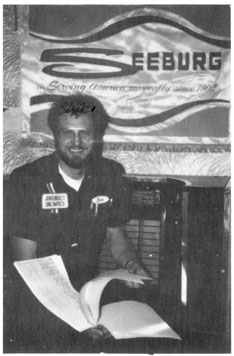
house for 35 years. Muller, who is 61, runs an
outfit called Jukeboxes Unlimited in Granada Hills (and
its offshoot, Jukeboxes for Rent, which rents to film
and TV studios and for events). He is the go-to jukebox
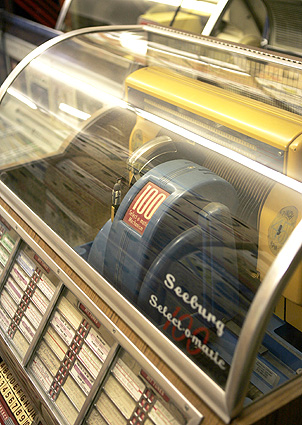
guy on the Westside when your classic '50s Seeburg or
Wurlitzer has a jammed record arm.
"The
kids don't know what a 45 or a single is. They don't
know what vinyl is," Muller says. "For me,
it's all about the 45's. The vinyl. The
feel. That's where the emotion is. You put
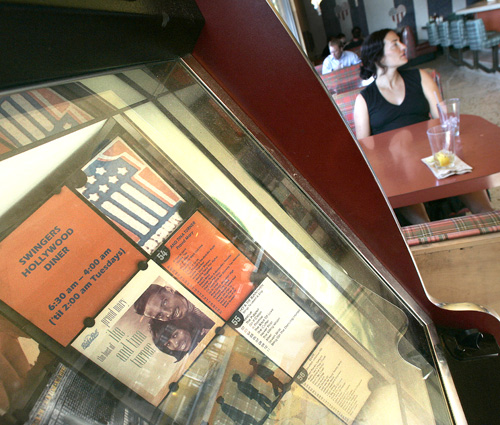
on a CD jukebox and you have thousands of titles. You
put on a vinyl jukebox and you've got 100 to 200 titles
... and that's special. Each record is
hand-picked. It's an art."
Muller
bought his first jukebox in 1971 from the Helm
Distributing Co. in Van Nuys. His business is
essentially a one-man show. He answers the phone, makes
house calls, stores and services about 30 jukeboxes in
his garage and makes custom music selections to order
for his rental boxes. When someone is having a
’50s party, he'll stock the box with appropriate
records, deliver and set it up. The biggest single
source of his business is film and TV rentals: His boxes
have appeared on everything from "Happy Days"
to a Bruce Springsteen video to a Miller beer ad.
In
this time, he has watched the jukeboxes that have been
around since 1927 go from ubiquitous music machines to
collectors' items. There used to be 600,000
jukeboxes in restaurants and bars in the U.S.
Today, that number is more like 150,000, according to
the Amusement & Music Operators Assn. in Chicago,
a trade group that publishes a magazine called
RePlay. These are no longer coin-operated (they
play for free), and they are invariably CD-based.
They are the sort of things most people wouldn't look at
twice.
So
who's buying all these classic and semi-classic vinyl
jukeboxes? Plenty of people. In this
country, there are a handful of national and regional
dealers, plenty of enthusiasts, and an Internet
community of jukebox nuts who buy and sell on websites
such as JukeboxesOnline.com. There are also
knockoff juke manufacturers, who make jukeboxes that
look like the classics but play CDs. These sell
for as little as a few hundred bucks in all the novelty
malls. And then there are the high-end producers,
like Rock-Ola Manufacturing Corp. in Torrance, which
makes a beautiful replica of a classic Rock-Ola 1426
from 1946 that plays CDs and sells for $7,999.
The
range of people who own jukeboxes is similarly
surprising. Tom Petty has two. Record producer Richard
Perry has a Seeburg in the living room of his house on
Sunset Strip. The Art Deco room has a bar and
walls full of instruments and gold and platinum records.
Like Muller, who sold him his 1978-79 Seeburg Disco
jukebox, his primary interest is in the music.
"I
was particularly fortunate to find this gem," he
says, beaming. "It sort of has an Art Deco
look, like it belongs here. This was the only
sound source they used in the disco; they'd just crank
it up. This is probably the most powerful jukebox
I've ever heard. The room gets pumping when that
thing is cranked."
As
a demonstration, he turns up "Love TKO"; at 50
watts per channel, it's flapping the potted
plants. Plus, he affirms, the jukebox experience
is hands-on fun. And everybody, himself included, loves
to choose music.
"I
dare you to name one person who doesn't find it fun to
stand around the jukebox and be part of programming
whatever music they want to hear," he says.
For
Perry, who has produced albums for artists from
Streisand to Ringo Starr to Carly Simon to the Pointer
Sisters, and continues today to have huge hits with
albums of standards by Rod Stewart, stocking the jukebox
is an art unto itself. His has 80 selections, and
his standards are high. He picks a song like Van
Morrison's "Moondance," for instance.
"Come on; that's a song that's great to hear
anytime, anywhere. I strive to have every song as
meaningful as that," he says.
So
his machine is packed with '40s big-band classics such
as Glenn Miller's "Moonlight Serenade," a
smattering of doo-wop and lots of R&B, Sinatra and
classic blues. There are about 60 selections, he
says, that he'll never change. The other 20 slots,
however, are for contemporary stuff, experiments. And
don't try to tell him that a CD jukebox would give him
more selections.
"The
CD jukeboxes have hundreds and thousands of selections,
and it leaves too much to someone else's potential bad
taste," he says with a smile.
For
others, taste may have other connotations.
Children of the alternative '80s and '90s find a jukebox
can be an ideal display site for that offbeat record,
that alternative single. Dan Epstein, a writer for
Revolver magazine and the author of "Big Hair and
Plastic Grass," a history of baseball in the '70s,
loves his 1972 Seeburg in large part because it reminds
him of the punk rock days at the Coconut Teaser on
Sunset.
"That
club had a Seeburg with this guy's amazing collection of
first-pressing 45s," Epstein says, "and the
jukebox was the entertainment between sets."
Epstein's
jukebox became a central fixture in his house after he
got it from Muller a few years ago.
"My
roommates and I used to hang out on the porch looking
into the living room watching the thing play," he
says, "because we loved listening to them and
watching the records change. That's one of the great
things about vinyl jukeboxes."
Everybody,
in fact, who has a jukebox seems to have strong opinions
on jukeboxes. Dan Epstein's older brother, the
former Rhino Records artistic director Sam Epstein (no
relation to Dan) claims nothing can usurp his 1958
Seeburg with 200 selections. He's a die-hard
collector of 45s, now owning more than 10,000, and
contends the ideal sonic and aesthetic environment for
discovering music is the jukebox.
"The
45 is the way it was originally intended, you know? For
a lot of early rock 'n' roll, a lot of vintage
vocalists, even the punk movement," Sam Epstein
says. "It's more organic than any of the
digital media, especially if you get an old Motown 45,
or an old Chess 45, and you hear Howlin' Wolf or Bo
Diddley. It's kind of like the whole box rumbles
and the room rumbles, and it's different each time you
play it."
Having
been at Rhino more than 25 years, Sam Epstein also loves
how what he calls "feeding the jukebox" leads
him to new music. His interests have led him to
make a film about the blues, still in production, called
"When Blue Men Sang the Whites." He'll ask
friends going home to Nigeria to bring him fresh juju
singles, or will set up his whole jukebox with
Bakersfield country.
"For
those who really like to play the records, this was the
machine," Epstein says of the Seeburg.
Tom
Blackwell points out this is an urge the downloadable or
Internet jukebox may not scratch sufficiently. He
notes that all commercial jukeboxes have about 20 songs
on them that are the hot sellers, the hits, and it's
always been that way. The Internet jukes offer so
many songs, and such little editing, that they're
actually not as fun. So far, he understands,
they're also not making much money.
Sam
Epstein points out that this is exactly why the home
jukebox is now so important. It's about selecting music,
programming it. The box keeps the 45 alive, and
45's keep whole genres of music alive.
"Pop
music is always going to be about what sells," he
says. "And the whole fun of my jukebox is
discovering things that were an obscurity — one of
mine was Sugar Pie DeSanto. She was a singer, a
pal of Etta James, still lives up in San Francisco,
putting out records. You'll never find that stuff
downloadable, or whatever. It just doesn't make
marketable sense. It's kind of like the haphazard
route of history."
|
|